

Jensen Huang resigned as Nvidia’s CEO on Thursday 12 November 2026, after a week in which the stock had already fallen hard. CFO Colette Kress is interim CEO. Our swarm of AI agents went through everything that matters for Nvidia right now: the filing, the price action, analysts’ calls, Reddit and X, and how other companies fared after losing their CEO to a scandal. Here is what they found, conclusions first. The details follow, for those who like them.
What does moneyheap’s analysis of Nvidia show?
Our agents read Nvidia as clearly bearish for the next week, neutral for the next few months and moderately bullish for six months. In short: the business hasn’t changed, the risk around it has, and the next few days belong to the risk.
| Time frame | Read | Confidence | Why |
|---|---|---|---|
| Next 7 days | Bearish, 32 | High, 80 | A sudden leadership vacuum, record volume (over 616 million shares) and the 17 November results landing while the CEO question is open |
| Next 1-3 months | Neutral, 48 | Mid, 60 | Kress has to prove the company runs without its founder, and the investigations hang over the stock; AI demand looks intact, as partners like CoreWeave keep raising their outlooks |
| Next 6 months | Bullish, 65 | Mid, 65 | Nvidia keeps its lead in AI chips and software and its large data center commitments; once a permanent CEO is in place, investors may pay more for its profits again |
Scores run from 0 (very bearish) to 100 (very bullish); confidence says how strongly the evidence backs the score. Both are our agents’ opinion, not a forecast. This read is from 2:17 PM New York time on 12 November, with the resignation included.
How the read moved over two months, with the three events that moved it:
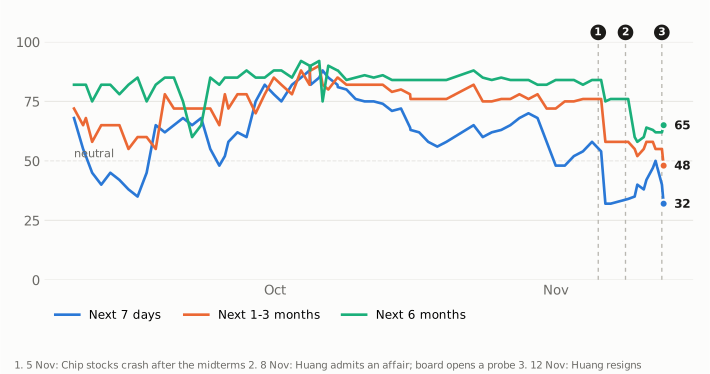
Three things stand out:
- For two months the long view barely moved. The six-month read stayed above 75 on all but two of 63 readings in September and October (median 84), while the short-term read swung between 35 and 88. That’s normal: weeks are noisy, the business wasn’t.
- The chip selloff hit the short term; the spy story hit the long term. After 5 November the seven-day read fell to 32 and the six-month read held at 76. After the affair news it was the other way round: the six-month read dropped to 60, and confidence fell to about 40 across the board, because the agents couldn’t tell how the board would decide.
- The resignation brought the confidence back, not the optimism. Once Huang was out, confidence rose to 80 for the next week and about 60 to 65 further out. The near term is now firmly bearish, the six-month view ticked up to 65. The uncertainty didn’t disappear; it moved from “what happens” to “how long it takes”.
Switch the chart to Confidence to see that drop and recovery. The latest read is on the Nvidia stock page.
What could happen next?
Nobody knows, and anyone who’s sure is selling something. Our agents see three paths, and what would point to each:
- Calm returns. The 17 November results beat the $108 billion revenue forecast, the outlook holds, Kress confirms the big customer deals, and the board gives a timeline for the CEO search. The story shifts from the CEO back to the numbers.
- A long wait. The results are fine, but the search drags on and the headlines keep coming: Huang’s testimony to Congress before Thanksgiving, the Justice Department inquiries, new export rules. The stock swings for months, waiting for a name.
- More trouble. Baird’s warning comes true (a write-down of up to $5 billion of inventory if chip exports to China are cut further), customers delay orders, or the outlook disappoints. Then the CEO story becomes a business story.
How did Nvidia stock react?
Down 14% at the open, down about 5% by noon, according to Yahoo Finance.
| 12 November | Price | vs Wednesday’s close |
|---|---|---|
| Open | $150.99 | -13.1% |
| Low | $148.80 | -14.4% |
| Around noon | $165.32 | -4.8% |
- Almost four normal days’ worth of shares traded by noon.
- Nvidia is about 31% below its record close of $239.24 on 6 October and is on its sixth weekly loss in a row. Microsoft passed it in market value on 10 November.
- Small investors were the ones buying. Vanda Research counted $111 million of net retail buying in the first 30 minutes, the largest opening retail bid it has ever recorded (Yahoo Finance).
So first the market sold everything, then it remembered that Huang didn’t take a single chip order with him. Nvidia is still worth about $4 trillion. Just fewer trillions than last month.
What are analysts saying?
More careful, not negative. Seven firms cut Nvidia to neutral and at least five cut their price targets, according to Yahoo Finance’s analyst data at noon on 12 November. Nobody we found moved to sell.
| Firm | Rating | Price target |
|---|---|---|
| Baird (11 Nov) | Outperform to Neutral | $500 to $200 |
| Evercore ISI | Outperform to In-Line | $465 to $186 |
| Bernstein | Outperform to Market Perform | $400 to $200 |
| Oppenheimer, KeyBanc, William Blair, StoneX | Positive to neutral | |
| Cantor Fitzgerald | Positive, kept | $350 to $250 |
| RBC Capital | Positive, kept | $330 to $230 |
| Citigroup | Buy, kept | $285 to $225 |
| Stifel | Buy, kept | $315 to $205 |
| Needham | Buy, kept | $300 to $200 |
Wedbush’s Dan Ives summed up the mood in two numbers: he values Nvidia at $300 with Huang and $225 without (CNBC). The rest split into two camps:
- “A shock, not a broken business.” StoneX sees no impact on revenue or profit estimates through 2028. Raymond James thinks the market overreacted. Fundstrat’s Tom Lee says the scandal doesn’t change his view. The argument: cloud and AI companies keep buying computing power whoever runs Nvidia.
- “Nvidia without Huang is a different company.” Evercore and KeyBanc point to the missing succession plan and higher execution risk. Bernstein expects more revelations. Oppenheimer warns of a brain drain. Goldman Sachs notes nobody inside has Huang’s reach for negotiating huge deals like those with OpenAI and Anthropic.
Note what the cuts are about. Analysts cut the price they’d pay, not the sales they expect. Nvidia’s numbers haven’t changed. The mood about them has.
What are people saying on Reddit and X?
Shock now, faith later. Finance threads split between buying the dip and worrying about who will lead Nvidia.
- “An accountant running an AI company.” The top comment in r/wallstreetbets’ thread on Kress (about 2,800 upvotes) said Nvidia without Huang might be the start of its decline. “Bean counter” was the word of the day, with Microsoft under Steve Ballmer and Intel as the cautionary tales.
- “Apple survived Steve Jobs.” The dip buyers argue that the chips, the CUDA software and the order book are the business, not one man.
- “Every dip looked like the bottom.” A popular r/wallstreetbets post reminded readers that each dip since the first spy report in late October looked like the last one.
- “It’s China, not the affair.” Others think the real risk is US export rules, which a new CEO doesn’t fix.
X sounds the same: fear for the next few weeks, cautious optimism for the next year. Social media is loud and fickle, so we read it as mood, not as a signal.
What happened to other companies when the CEO left in a scandal?
It depended on the business and the successor, not on the scandal: a year later, anywhere from +76% to -30% (Yahoo Finance price history).
| Company | CEO exit | One week later | One year later |
|---|---|---|---|
| Apple, 2011 | Steve Jobs, health (planned handover to Tim Cook) | +2% | +76% |
| McDonald’s, 2019 | Steve Easterbrook, relationship with an employee (successor named the same day) | 0% | +10% |
| Intel, 2018 | Brian Krzanich, past relationship with an employee (CFO as interim) | -9% | -12% |
| Wynn Resorts, 2018 | Steve Wynn, misconduct allegations | +1% | -20% |
| HP, 2010 | Mark Hurd, expenses and harassment probe (CFO as interim) | -13% | -30% |
Two patterns stand out. The resignation day was rarely the lowest point. And the two cases most like Nvidia’s, a CFO as interim CEO with an open search, both lagged a year later: Intel’s on chip delays and HP’s on a bad outside hire. Apple is the comparison everyone wants, but Apple had a long, planned handover. Nvidia had a Thursday.
What should you watch next?
- 17 November, after the close: the quarterly report. Nvidia’s forecast is $108 billion of revenue (give or take 2%) and a 74% gross margin. It has beaten its own forecast by about 5% in each of the last four reports. Options traders expect a move of about 9% to 11% either way. The outlook for next quarter matters more than the quarter itself.
- 18 to 19 November: Trump and Xi meet at the APEC summit, where chip exports are on the table.
- Before 26 November: Huang testifies to Congress, according to the chair of the House Foreign Affairs Committee.
- The CEO search. An engineer from inside, a known outsider, or Kress for longer: each tells the market something different.
Our Market Stories follow the news that moves Nvidia as it comes in.
Why did Jensen Huang resign?
Nvidia hasn’t said. Its filing with the SEC only says he resigned “effective immediately”. He left after a week of reports about two affairs: one with a businesswoman US intelligence reportedly considers a Chinese asset, and one with a Nvidia vice president.
- Sunday 8 November. Huang admitted the first affair in an email to staff. The board opened an independent investigation and said it still had confidence in him (our earlier post covers that day).
- Wednesday 11 November, evening. The New York Times reported the second affair, and The Wall Street Journal reported that the board was preparing to remove him. The stock fell about 8% after hours.
- Thursday 12 November, morning. The resignation, a new chair and an interim CEO, all in one filing.
The first affair was a personal matter with a national security question attached. The second broke the most basic workplace rule: no relationships with someone who reports to you. Boards rarely negotiate on that one. Officially it’s a resignation; most reporting reads it as a resignation the board asked for.
Who runs Nvidia now?
Colette Kress, Nvidia’s CFO since 2013, is interim CEO and stays CFO. Harvey Jones, a former CEO of chip design software maker Synopsys, becomes the board’s first-ever chair. The board will consider internal and external candidates for the permanent job.
Nvidia never needed a succession plan, and it shows. Huang had about 60 people reporting directly to him, which leaves no obvious number two. The names in the press so far:
- Inside: Ian Buck, who built Nvidia’s data center business, is the name analysts mention most, then Kress herself.
- Outside: Arm’s CEO Rene Haas, a former Nvidia executive. President Trump suggested Apple’s Tim Cook on Truth Social; nothing suggests the board is considering him.
The board says operations, customer orders and the product roadmap continue “without interruption”. The first test comes on Tuesday 17 November, when Nvidia reports its quarterly results as planned.
Frequently asked questions
Was Jensen Huang fired?
Officially he resigned, and Nvidia gave no reason. The Wall Street Journal had reported the night before that the board was preparing to remove him, so most coverage reads it as a forced exit. A company spokesperson told NBC he won’t work with Nvidia in any capacity.
Does Jensen Huang still own Nvidia stock?
As far as public filings show, yes. In 2025 he held about 3.5% of the company, and leaving doesn’t sell his shares. Any sale would appear in filings.
Who is Colette Kress?
Nvidia’s CFO since 2013, and before that a finance executive at Cisco and Microsoft. She has presented Nvidia’s numbers on every earnings call of the AI boom. She isn’t an engineer, which is exactly what part of the market worries about.
Will Nvidia still report earnings on 17 November?
Yes. The filing confirms the report on Tuesday 17 November after the market closes, with the call at 5:00 PM New York time.
Is the Nvidia selloff an overreaction?
Both sides have a case. Nvidia’s sales forecast hasn’t changed, and no major analyst moved to sell. But it lost the founder who set its direction, and it faces legal and political risks that a new CEO doesn’t remove. The 17 November results are the first hard evidence either way.
How we wrote this
Sources: Nvidia’s 8-K filing of 12 November 2026; coverage by CNBC, Yahoo Finance, NBC, Investing.com and IBTimes from 8 to 12 November; prices and analyst ratings from Yahoo Finance at about noon New York time on 12 November; and public Reddit and X posts from 11 and 12 November. The historical comparisons use Yahoo Finance closing prices against the last close before each announcement. Prices are snapshots and kept moving after we wrote this.
The moneyheap scores come from our agents’ stored analyses of Nvidia from 8 September to 2:17 PM New York time on 12 November, one point per analysis; copies made later for model calibration are left out. The analyses ran on two AI models (Gemini for the daily and manual runs, Claude for the intraday trending runs), so part of the small zigzag is the model, not the news. Scores are opinions, not guarantees. See how moneyheap analyzes the market and our risk disclosures. We’ll update this post after the 17 November results.
moneyheap is a market research tool. This post is for information and education only. It is not financial advice or a recommendation to buy or sell any security. Do your own research.
 Artem Kondyukov · 9 min read